

Agency operations are everything happening behind the scenes that allows your team to deliver work successfully.
Clients. Projects. Tasks. Employees. Freelancers. Documents. Payments. Services. Deadlines.
When these elements are managed separately, even a successful agency can become difficult to operate.
The solution isn’t necessarily adding more tools.
Start With Your Clients
Your client should be the center of your agency’s operational information.
A client record should provide your team with quick access to important information such as services, contacts, projects, websites, social media accounts, documents, and relevant history.
This eliminates the need to search through multiple platforms to understand a client’s relationship with your agency.
Organize Your Team
Knowing who works at your agency isn’t enough.
You need to know:
- Who is responsible for what?
- Which tasks are assigned to them?
- What projects are they involved in?
- What work is currently pending?
- Where are the bottlenecks?
A structured team management system creates greater visibility and accountability.
Manage External Providers
Many agencies depend on freelancers and external specialists.
Instead of keeping provider information in scattered spreadsheets, create structured provider profiles containing relevant information such as:
Service → Pricing → Availability → Documents → Reviews → Assigned Clients → Work History
This turns your provider database into an operational asset.
Connect Tasks to the Bigger Picture
A task shouldn’t exist in isolation.
It should be connected to the client, project, responsible person, deadline, and status.
This gives managers context instead of simply showing a list of tasks.
Centralize Documents
Important agency documents can easily become difficult to find.
Contracts, proposals, client documents, provider information, and project files should be organized in a way that allows authorized team members to access them quickly.
Create Repeatable Processes
If your team performs the same process repeatedly, document and structure it.
For example:
New Client → Onboarding → Assign Team → Create Tasks → Execute → Client Review → Approval → Delivery
A repeatable workflow helps your team deliver consistent results while reducing dependency on individual knowledge.
Add Visibility Through Dashboards
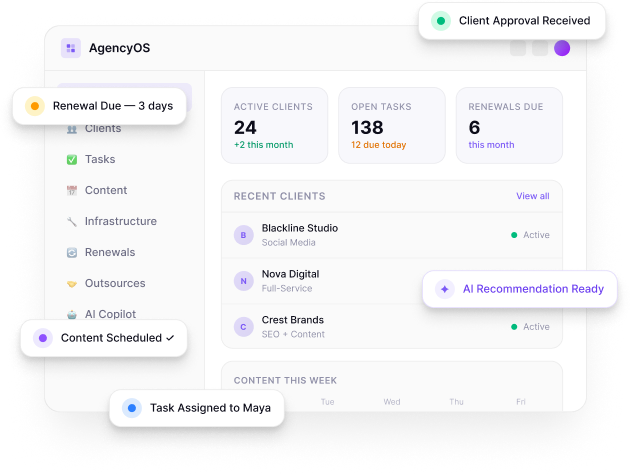
A dashboard should answer the most important operational questions quickly.
-What’s happening?
-What needs attention?
-What’s overdue?
-Who is responsible?
-Where are the bottlenecks?
Instead of searching through information, managers should be able to see the bigger picture immediately.
Bring Everything Together
The goal isn’t to put every piece of information into one giant database.
The goal is to connect the information that needs to work together.
Clients connect to projects.
Projects connect to tasks.
Tasks connect to team members.
Providers connect to services.
Documents connect to clients and providers.
Reports connect to operational activity.
That’s what creates a true operational system.
Organize Once. Operate Better.
When your agency has a clear operational structure, your team spends less time searching, asking, updating, and following up—and more time delivering valuable work.
AgencyOS brings the essential parts of agency operations together in one centralized workspace.

