


10 Signs Your Agency Has Outgrown Spreadsheets
Spreadsheets are useful.
They’re flexible, inexpensive, and easy to start with. That’s why many agencies use them to track clients, projects, providers, budgets, tasks, and operational information.
But eventually, the spreadsheet that once helped organize your agency can become part of the problem.
Here are 10 signs your agency may have outgrown spreadsheets.
1. You Have Multiple Versions of the Same File
If your team regularly asks, “Which spreadsheet is the latest one?” you already have an information management problem.
Multiple versions create confusion and increase the risk of working with outdated information.
2. Your Team Depends on Manual Updates
If someone needs to constantly update rows, statuses, formulas, and information manually, your system is consuming valuable time.
The larger the agency becomes, the more difficult this gets.
3. Information Is Scattered Across Multiple Files
One spreadsheet for clients.
Another for freelancers.
Another for projects.
Another for expenses.
Another for social media.
At some point, finding information becomes a task itself.
4. Managers Don’t Have Real-Time Visibility
Agency owners need answers quickly.
Which projects are active?
What is overdue?
Who is responsible?
Which clients need attention?
If answering these questions requires opening several files and contacting team members, your system isn’t giving you enough visibility.
5. Your Team Keeps Asking for Information
When information isn’t easily accessible, team members constantly ask managers or colleagues for updates.
This creates interruptions and slows everyone down.
6. Tasks Are Managed Somewhere Else
If client information is in Excel but tasks are in another platform, communication happens through messaging apps, and documents are stored elsewhere, your workflow becomes fragmented.
7. Your Agency Is Adding More People
A spreadsheet may work for a small team, but onboarding new employees becomes harder when understanding the agency depends on knowing where different files are stored.
8. You Manage Many External Providers
Freelancers, developers, designers, photographers, influencers, SEO specialists, and other providers can quickly become difficult to track using spreadsheets alone.
You need more than a name and phone number.
You may need services, pricing, documents, reviews, clients assigned, and work history.
9. Reporting Takes Too Long
If preparing a simple management report requires manually collecting information from different spreadsheets, your reporting process is costing you time.
10. Your Spreadsheet Has Become a System
This is perhaps the biggest warning sign.
If your spreadsheet contains dozens of tabs, complex formulas, color-coded statuses, filters, instructions, and workarounds, you’re no longer simply using a spreadsheet.
You’re trying to build an agency management system inside one.
So, Should You Stop Using Spreadsheets?
Not necessarily.
Spreadsheets still have their place.
The problem begins when you’re forcing them to handle workflows, collaboration, accountability, automation, reporting, and operational management that they weren’t designed to handle.
That’s when a centralized agency management platform can make a major difference.
From Spreadsheet Chaos to Operational Clarity
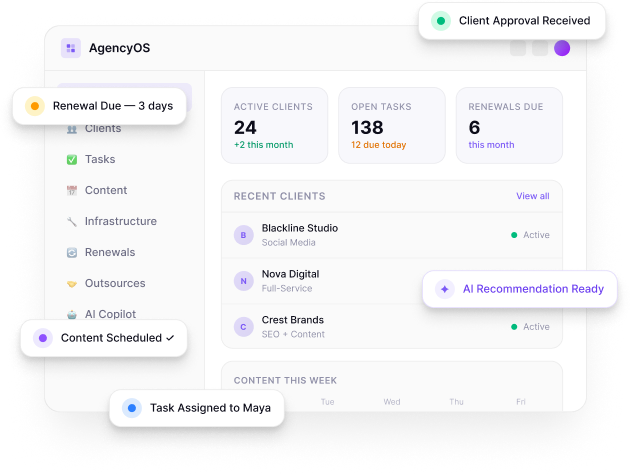
AgencyOS gives agencies a structured environment to manage clients, teams, providers, tasks, documents, and operations without relying on disconnected spreadsheets.
Instead of asking:
“Where is that file?”
Your team can ask:
“What needs to happen next?”
Ready to move beyond spreadsheets? Start Free.

